If you change straps often, sooner or later you start looking for better tools than a simple spring bar pick. That search usually leads to the Bergeon 6825 series, a family of plier style spring bar tools designed to remove bracelets faster and with more control. They look simple, but if you ever struggled with solid end links, tight lug gaps, or stubborn spring bars, you know why these tools have a loyal following. Yet there is a question almost everyone runs into: should you buy the Bergeon 6825 or the 6825-PF, and what’s the difference between them?
They share the same body, the same adjustment system, and the same overall design. The difference sits almost entirely in the forks, and that small difference dramatically affects how the tool behaves around tight tolerances.
This guide explains how both models work, how they compare, and which one is right for the watches you actually own.
How the Bergeon 6825 works
The Bergeon 6825 belongs to a category sometimes called “spring bar pliers.” Instead of using a single fork from one side, both jaws carry a fork. This means the tool grabs both spring bar shoulders at once. A controlled squeeze compresses the bar so you can slide the bracelet out cleanly.
Unlike traditional tools, you are not trying to push one end free while hoping the other stays compressed. You remove everything in one motion, which can feel almost effortless once the forks are aligned correctly.
The 6825 design offers three practical benefits:
- Speed on solid end links that traditionally fight back
- Even pressure, which helps avoid bending the spring bar
- More control, since both shoulders are handled simultaneously
That said, fork alignment matters. The forks must sit cleanly on the shoulders. If they slip, they can skate against the case or end link. This is why fork width, tip thickness, and shape make a big difference.
What both models share

Before we dig into differences, it is worth understanding what the 6825 and 6825-PF have in common. A lot, actually.
The body, adjustment range, and mechanics are identical. If you held both versions with the forks removed, you could not tell them apart.
Same tool body and adjustment
Both models use the same compact aluminium plier body. They include:
- A working width adjustable from about 10 mm to 30 mm
- A locking screw that holds your chosen width steady
- Fork mounting points that rotate between straight (0°) and 45° positions
- An overall length of roughly 95 mm
In the hand, they feel the same. Same balance, same spring tension, same handling.
A quick comparison:
| Feature | 6825 | 6825-PF |
|---|---|---|
| Body material | Aluminium | Aluminium |
| Adjustment range | 10–30 mm | 10–30 mm |
| Fork angle options | 0° and 45° | 0° and 45° |
| Overall length | ~95 mm | ~95 mm |
They behave identically until you look at the fork tips.
Same fork system
Both pliers accept the same fork tips. This system includes:
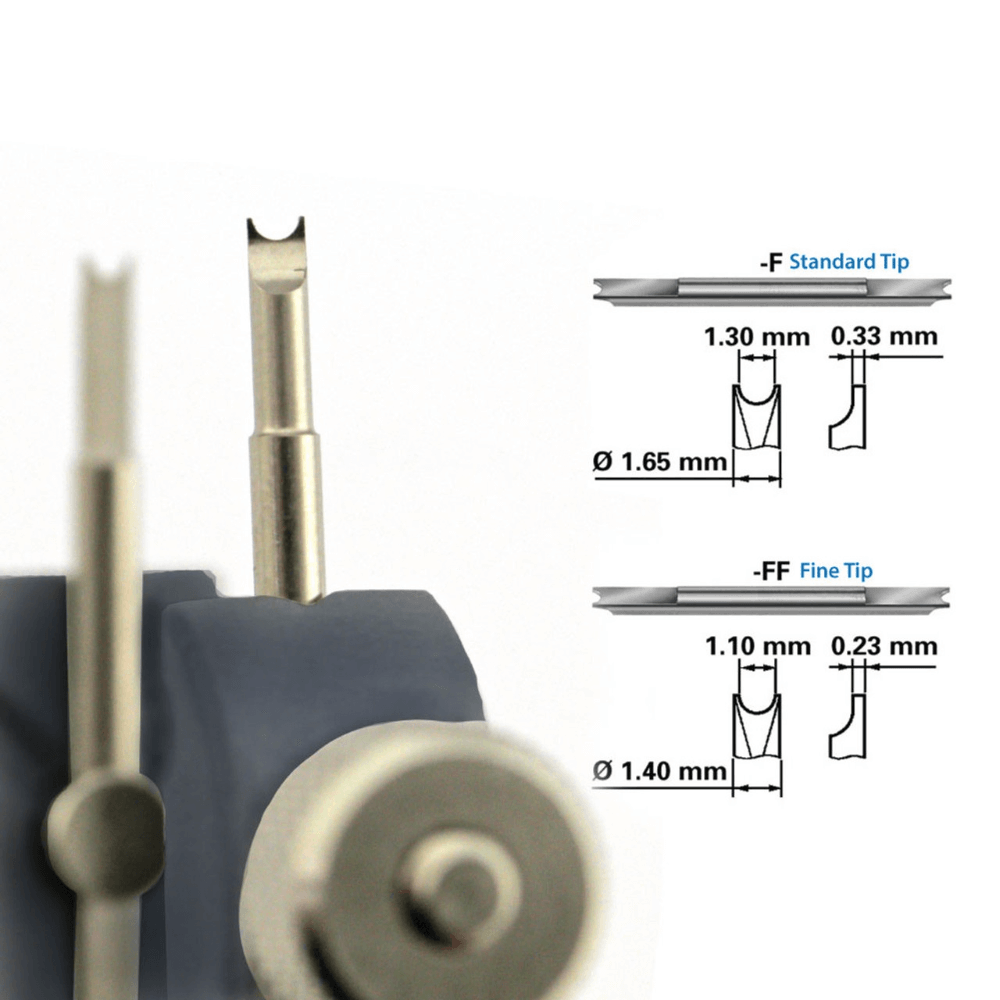
- Standard forks (6825-F): ~1.30 mm wide, ~0.33 mm tips
- Fine forks (6825-FF): ~1.10 mm wide, ~0.23 mm tips
- Extra fine forks: ~1.00 mm wide with very slim engagement points
The forks are also reversible, so you can flip them if one side wears out.
A fork options summary:
| Fork Type | Width | Tip Thickness | Best For |
|---|---|---|---|
| Standard (6825-F) | ~1.30 mm | ~0.33 mm | General steel bracelets |
| Fine (6825-FF) | ~1.10 mm | ~0.23 mm | Tight lug gaps, recessed bars |
| Extra fine | ~1.00 mm | Very thin | Ultra tight tolerances, delicate cases |
This means the primary difference between the 6825 and 6825-PF is simply the forks they come with.
Bergeon 6825: the standard fork all-rounder

The Bergeon 6825 is the version most enthusiasts see first. It is designed as a general purpose bracelet removal tool that fits the needs of mainstream collectors.
With standard 1.30 mm forks, it provides a stable, sturdy feel and enough width to grab most spring bar shoulders confidently.
Configuration
The supplied standard forks make the tool feel robust. They are not overly thick, but the slight extra width improves durability and helps control beefier spring bars.
Where the 6825 shines
The standard 6825 performs well in a wide range of scenarios:
- Everyday divers and sports watches
Perfect for Seiko, Omega, micro-brands, and similar designs with accessible spring bars. - Thicker spring bars
The bigger contact surface gives better pressure control on 1.8 mm and 2.0 mm bars. - More tolerance for heavy hands
Thicker forks handle occasional misalignment better and bend less easily. - Best overall value
If you later need finer forks, you can simply buy tips rather than a whole new tool.
A simple compatibility overview:
| Watch Category | Performance with 6825 |
|---|---|
| Seiko, Citizen, micro-brands | Excellent |
| Omega steel bracelets | Excellent |
| Vintage dress watches | Good |
| Rolex / Tudor (modern) | Fair to poor |
| Watches with narrow lugs | Inconsistent |
Where the 6825 struggles
It does have limits:
- Modern Rolex and Tudor bracelets: Their spring bar shoulders hide deep behind the end link. Standard forks are often too wide to reach them reliably.
- Narrow dress watch lugs: Slim polished cases allow very little space for tool tips, making wider forks risky.
If your collection leans toward tight tolerances, the 6825 can feel clumsy.
Bergeon 6825-PF: the fine tip specialist

The 6825-PF is designed for precision. The tool body is identical, but the forks are slimmer, sharper, and designed for tight access.
Fine forks change everything when working with recessed spring bars.
Configuration
The PF ships with fine 1.10 mm forks, which provide:
- Better access in tight gaps
- More space between the fork body and the case
- A more precise “bite” on the spring bar shoulders
Where the 6825-PF shines
Fine forks excel in three key areas:
- Recessed bars on modern Rolex and Tudor
These end links sit very close to the case, leaving extremely narrow access points. - High polish or delicate cases
The slimmer body reduces the chance of rubbing against the lug wall. - Strap changes on expensive watches
If you swap bracelets often, precision matters more than durability.
A quick compatibility overview:
| Watch Category | Performance with 6825-PF |
|---|---|
| Rolex (modern) | Excellent |
| Tudor (modern) | Excellent |
| High polish cases | Excellent |
| Seiko, micro-brands | Very good |
| Thick spring bars | Good to fair |
| Cheap bracelets / soft bars | Can be risky |
Where the 6825-PF struggles
Precision also brings weaknesses:
- Forks are easier to bend
A heavy hand or sideways force can deform the tips. - More pressure on shoulders
The smaller contact area focuses force more narrowly. - Slightly higher cost
You pay for the fine setup, even though the body is the same.
For rugged bracelets, the PF can feel a little too fragile.
Side by side comparison
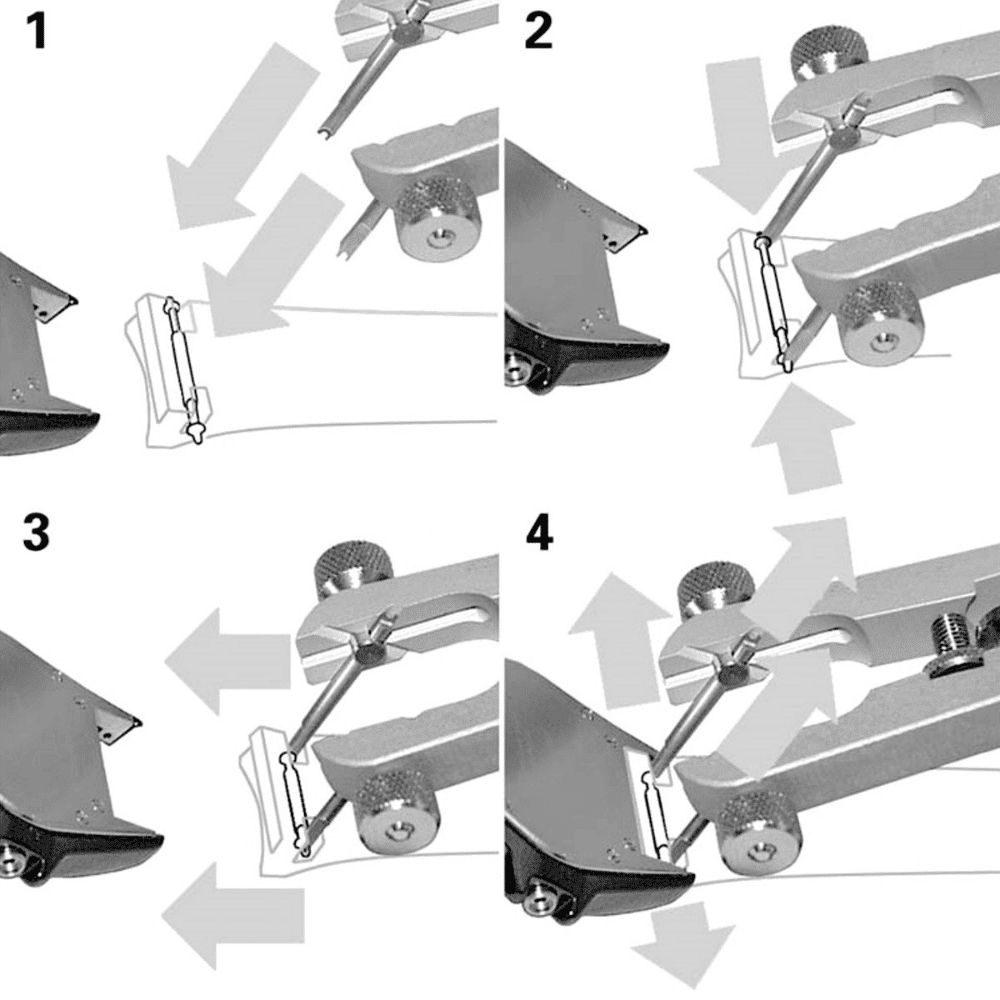
Below is a direct comparison of both versions.
Specifications table
| Feature | 6825 | 6825-PF |
|---|---|---|
| Supplied Fork Type | Standard | Fine |
| Fork Width | ~1.30 mm | ~1.10 mm |
| Tip Thickness | ~0.33 mm | ~0.23 mm |
| Best Use Case | General bracelets | Tight, recessed bars |
| Forgiveness | Higher | Lower |
| Precision | Lower | Higher |
Real world compatibility
| Watch Type | 6825 | 6825-PF |
|---|---|---|
| Seiko / Citizen | ✓✓✓ | ✓✓ |
| Omega | ✓✓✓ | ✓✓ |
| Rolex | ✓ | ✓✓✓ |
| Tudor | ✓ | ✓✓✓ |
| Dress watches | ✓ | ✓✓ |
| Vintage pieces | ✓ | ✓✓ |
| Cheap bracelets | ✓✓ | ✓ (delicate tips) |
This makes the differences clearer: the 6825 is a generalist, the PF a precision instrument.
Price and long term value
Both versions typically sell in the same price bracket. The plier body is the expensive part, while forks are relatively affordable.
A smart long term strategy is:
- Choose the version that suits your main watches today.
- Add forks over time as your collection grows.
A simple value summary:
| Factor | 6825 | 6825-PF |
|---|---|---|
| Best starting option for most collectors | ✓✓✓ | ✓ |
| Best for Rolex / Tudor owners | ✓ | ✓✓✓ |
| Cost of spare forks | Low | Low |
| Long term flexibility | High | High |
Which one should you buy?

Choosing between the two becomes easy once you match them to your collection.
For professionals
Professionals see everything from budget beaters to high end luxury pieces. For that reason:
- Choose the 6825 if most work involves mainstream watches.
- Choose the 6825-PF if you regularly service Rolex, Tudor, and other tight tolerance bracelets.
Then build a fork set with both standard and fine tips.
This gives full flexibility on one tool system.
For enthusiasts with mixed collections
Most collectors own a blend of Seiko, micro-brands, Omega, and maybe one or two high end pieces.
For this mix, the 6825 is usually the best starting point.
It is more forgiving and handles most bracelets well.
If your most valuable watch already has tight tolerances, the PF becomes the safer long term choice.
For Rolex and Tudor owners
If you own multiple models from either brand, the answer is clear:
Choose the 6825-PF.
Modern Rolex and Tudor bracelets are designed with very small clearances, and the PF forks handle this environment far better.
How to use either tool safely
Good technique is more important than the model number on the tool. Even with the right forks, rushing can cause slips or scratches.
Set the width before touching the watch
Always adjust the pliers on the bracelet first:
- Fit the pliers around the bare bracelet end link
- Align both forks on the spring bar shoulders
- Lock the width
- Test a few squeezes
- Only then move to the watch
This reduces surprises when working near the case.
Support the watch properly
Always work on a soft, stable surface:
- Lay the watch face down
- Let the lugs rest on the pad
- Approach from the case back side
- Use gentle, downward pressure toward the pad
This keeps slips away from visible surfaces.
Use fork angle settings
The 0° and 45° fork positions have different uses:
- Use 0° for straightforward end links
- Use 45° when crown guards or case curves block a straight approach
Experiment on a cheaper bracelet first to see what gives you the best angle.
Know when to use another tool
Spring bar pliers are not always the right solution. A simpler tool may be safer when:
- Working with leather straps
- Removing bars from drilled lugs
- Handling cheap, corroded, or soft metal bars
Think of the 6825 family as a specialist tool, not a universal one.
FAQ
- Do both models use the same fork tips?
Yes. Both accept standard, fine, and extra fine tips.
- Can a 6825 become a 6825-PF with fine forks installed?
Functionally, yes. The fork tips determine the effective model.
- Will either tool guarantee scratch free results?
No. Technique, lighting, and patience play a bigger role than fork width.
- Which model is better for beginners?
The 6825 is more forgiving and easier to learn on.
Final Thoughts
The Bergeon 6825 and 6825-PF share the same body, adjustment system, and engineering. The difference that matters is fork size.
- The Bergeon 6825 is the strong all-rounder with standard forks. It works brilliantly on most steel bracelets and everyday watches.
- The Bergeon 6825-PF is the precise, fine tip version designed for tight tolerances, narrow lug openings, and recessed spring bars. It is the go to choice for modern Rolex and Tudor owners.
If your collection includes mostly everyday tool watches and mainstream bracelets, start with the 6825 and add fine forks later. If tight tolerance luxury pieces dominate your box, go straight to the PF.
Pair the right tool with good technique and you will change bracelets faster, cleaner, and with far less stress every time.