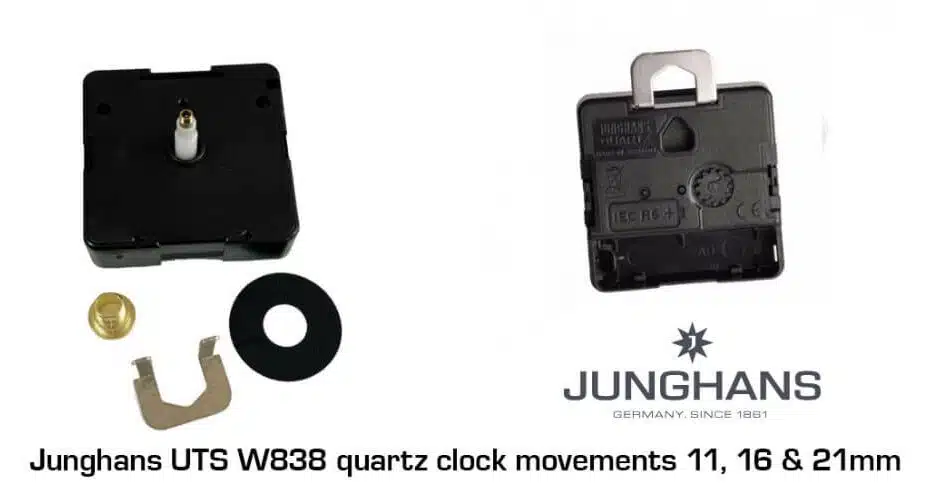
When replacing a Junghans UTS W838 quartz clock movement, many buyers focus on the number in the product title: 11mm, 16mm, 21mm, and so on. At first, this measurement can seem confusing. Some assume it refers to the overall movement size. Others think it describes the hand size or the diameter of the center shaft. However, in the Junghans UTS W838 quartz clock movement, the millimeter size usually refers to the shaft length.
More specifically, it refers to the threaded hand shaft that protrudes through the clock dial. Therefore, the difference between an 11mm and 16mm W838 movement is not the movement body size. Instead, it is the shaft length that passes through the dial and holds the hands in place.
This detail matters because the shaft must be long enough to pass through the dial, accept the mounting nut, and still leave enough room for the hour, minute, and second hands. However, it should not be excessively long, as too much shaft can cause the hands to sit too far from the dial or create an awkward fit.
If you are replacing an existing Junghans or UTS W838 movement, choosing the right shaft length is one of the most important steps.
What Does 16mm Mean?
A Junghans UTS W838 16mm movement has a hand shaft that projects approximately 16mm from the movement. This version suits thicker dials than the 11mm version. In practical terms, a 16mm shaft often works for clock dials around 6.8mm to 8mm thick, depending on the mounting hardware and hand setup.
By comparison, an 11mm W838 movement suits thinner dials, usually around 3mm thick. Therefore, if your clock dial is thin, the 11mm version may fit better. However, if your dial is thicker, the 16mm version usually provides the mounting nut with enough threads to secure the movement properly.
The movement body itself remains approximately 56 × 56 × 17–18mm across common W838 versions. Product listings for UTS W838 movements commonly list work dimensions of around 56 × 56 × 18mm and a battery type of LR6/AA, while separate shaft options determine dial compatibility.
The MM Size Refers To Shaft Length, Not Body Size
The most common mistake buyers make is assuming that “11mm” or “16mm” describes the movement case. It does not.
The main movement body stays essentially the same. Therefore, a Junghans UTS W838 11mm movement and a Junghans UTS W838 16mm movement can share the same movement footprint. The difference sits at the front of the movement, where the threaded shaft and hand arbor extend through the dial.
Several supplier listings describe the W838 or UTS 800 shaft length as the length of the hand axis projecting from the movement. They also connect each shaft length to a recommended maximum dial thickness. For example, one UTS 800 listing states that the 11mm shaft suits dials up to about 3.0mm, the 13mm shaft suits about 4.5mm, the 16mm shaft suits about 6.8mm, the 20mm shaft suits about 12.0mm, and the 26mm shaft suits about 20.0mm.
Consequently, the mm size helps you match the movement to your clock dial thickness.
Shaft Length And Dial Thickness Chart
Use this table as a practical guide when choosing between common Junghans UTS W838 shaft lengths.
| W838 Shaft Length | Typical Maximum Dial Thickness | Best Use Case |
|---|---|---|
| 11mm | About 3mm | Thin clock dials |
| 13mm | About 4.5mm | Light-to-medium dials |
| 16mm | About 6.8–8mm | Medium-thick dials |
| 20mm / 21mm | About 10–12mm | Thick wooden or decorative dials |
| 26mm | About 16–20mm | Very thick clock faces |
Different suppliers sometimes list slightly different ranges for dial thickness. For example, one listing gives 16mm as suitable up to 7.00mm, while another lists 16mm as suitable up to approximately 8.5mm in a high-torque UTS 800 version. Therefore, you should treat these numbers as practical fit ranges rather than exact universal limits.
Why The Correct Shaft Length Matters
The shaft length controls how securely the movement mounts to the dial. If the shaft is too short, the threaded portion may not extend far enough through the clock face. As a result, the mounting nut may not tighten properly. In that case, the movement can shift behind the dial, and the hands may rub or sit unevenly.
On the other hand, a shaft that is too long can also create problems. The hands may sit too far forward from the dial, which can look incorrect. Additionally, the extra height may reduce hand stability or create clearance issues under a glass cover.
Therefore, the correct shaft length should provide just enough projection through the dial for secure mounting and clean hand installation.
11mm Vs 16mm: Which One Do You Need?
The 11mm and 16mm versions are among the most common choices. However, they serve different dial thicknesses.
Choose the Junghans UTS W838 11mm quartz clock movement if your dial is thin. This version works best when the clock face is only a few millimeters thick. For many metal, plastic, or thin wooden dials, 11mm provides a clean and compact fit.
Choose the Junghans UTS W838 16mm quartz clock movement if your dial is thicker. This version offers more shaft length, so it works better with medium-thickness clock faces. Many replacement projects use 16mm because it provides extra mounting clearance without becoming excessively long.
If your dial is thicker still, consider the Junghans UTS W838 21mm quartz clock movement. This size can suit deeper wooden dials, decorative clock faces, or clocks where the movement sits behind a thicker panel. Some suppliers list 21mm or similar longer variants for dials around 10mm thick, depending on the version and hardware supplied.
How To Measure Your Clock Dial
Before ordering, measure the dial thickness carefully. This step reduces returns and prevents installation problems.
First, remove the old movement if possible. Then measure the thickness of the clock dial where the shaft passes through. Use calipers for the most accurate result. If you do not have calipers, use a ruler carefully, but remember that a few millimeters can make a major difference.
Next, inspect the old movement. Measure how much of the threaded shaft protrudes through the dial. Also, check how much thread remains after the mounting nut. This tells you whether the existing shaft length worked well or felt too short.
Finally, compare your measurements with the shaft chart. If your dial measures close to the upper limit of one shaft length, choose the next longer size. For example, if your dial measures nearly 7mm, the 16mm version may work better than the 11mm.
Movement Body Size Usually Stays The Same
Another important point involves the movement of housing. In most W838 replacement situations, the body dimensions do not change significantly between shaft lengths.
Common specifications list the W838 body around 56 × 56 × 18mm, excluding the suspension or hanger. Some listings also mention an LR6/AA battery, central screw mounting, and Euro shaft hand compatibility.
Therefore, if your old W838 body fits behind the dial, the main question usually becomes shaft length rather than housing size. However, you should still confirm clearance behind the dial, especially if the clock case has a shallow back.
Hand Compatibility Matters Too
Choosing the correct shaft length does not guarantee that your old hands will fit. The W838/UTS 800 series often uses Euro shaft hands. One supplier specifically notes that the UTS 800 former Junghans W838 movement works only with Euro shaft hands.
This means you should check the hole sizes before reusing old hands. If the hands do not match the shaft standard, they may sit loosely, fail to install, or damage the movement.
Therefore, when replacing a movement, confirm three things:
- Shaft length
- Dial thickness
- Hand-fitting type
Together, these details determine whether the replacement will install cleanly.
Common Mistakes When Ordering A W838 Movement
Many replacement problems come from simple measurement errors. Fortunately, you can avoid most of them.
Common mistakes include:
- Assuming 16mm means the body size
- Measuring the full clock case instead of the dial thickness
- Ignoring the threaded portion needed for the mounting nut
- Ordering 11mm for a thick wooden dial
- Reusing hands without checking the Euro shaft compatibility
- Forgetting clearance under the front glass
- Choosing a shaft that is much longer than necessary
Additionally, do not rely only on the old product title if the clock has been repaired before. Someone may have installed the wrong movement in the past.
Practical Buying Advice
If your dial is very thin, choose 11mm. If your dial is around medium thickness, choose 16mm. If your dial is thick or decorative, choose 21mm or longer.
However, when you’re unsure, measure the dial and choose the shortest shaft that still provides enough thread for secure mounting. This approach usually creates the cleanest hand position and best visual result.
As a simple rule:
| Dial Situation | Recommended Choice |
|---|---|
| Thin metal or plastic dial | 11mm |
| Medium wood or thicker dial | 16mm |
| Thick wood or decorative dial | 21mm |
| Very thick handmade dial | 26mm |
Final Thoughts
The mm size in a Junghans UTS W838 quartz clock movement refers to the shaft length, not the movement body size. Therefore, an 11mm, 16mm, or 21mm version mainly changes how far the threaded hand shaft projects through the clock dial.
For thin dials, the 11mm version usually works best. For medium-thickness dials, the 16mm version often provides the right fit. For thicker clock faces, the 21mm version gives extra mounting reach. Meanwhile, the movement body remains approximately 56 × 56 × 17–18mm across these common versions.
Ultimately, the best way to choose the right movement is simple: measure the dial thickness, check the old shaft projection, confirm Euro-hand compatibility, and select the shortest shaft that fits securely. This careful approach helps you avoid poor hand alignment, loose movement mounting, and unnecessary returns.